Strike the Ground: Practical Lessons on Faith, Obedience, and Breakthrough

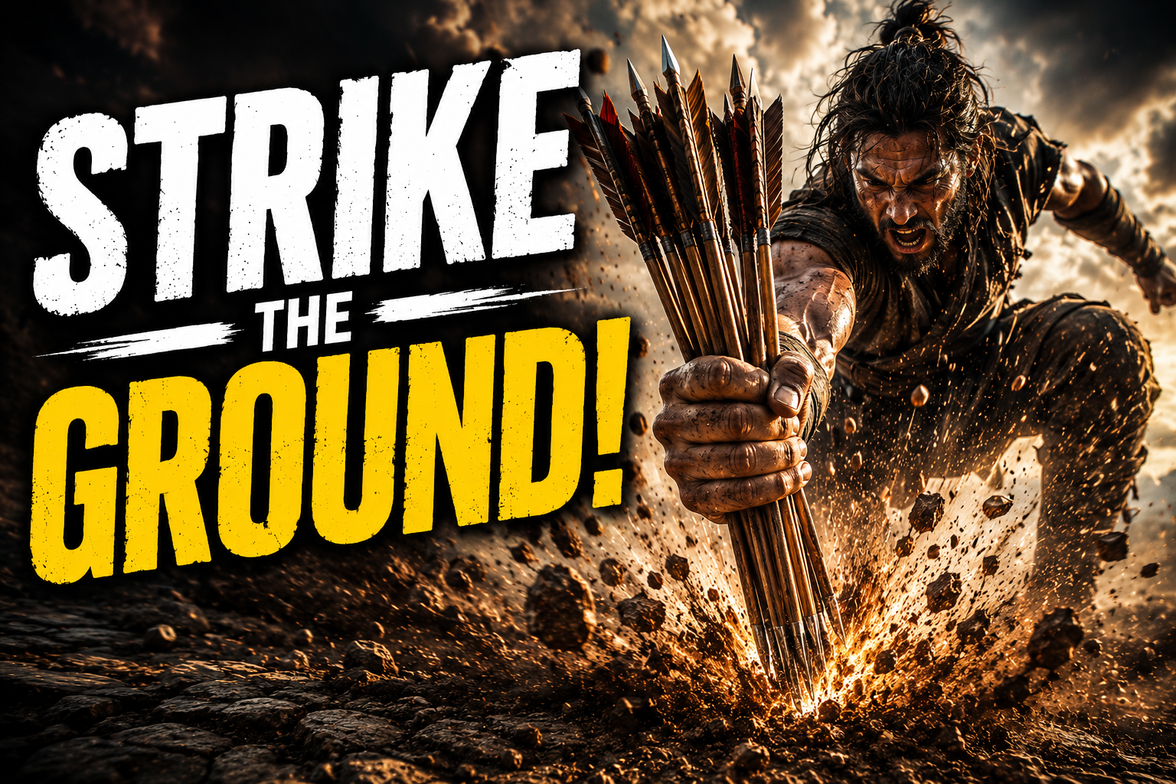
There is a difference between believing God can do something and responding like you actually expect Him to do it.
That is the tension in 2 Kings 13:14-19. Elisha is near the end of his life. King Joash comes to him weeping, carrying the weight of a battle he knows he cannot win on his own. Syria, or Aram, has been a persistent enemy. The king needs strategy, help, and assurance. What he receives is a prophetic lesson in faith.
Elisha tells him to take a bow and arrows. He places his hands on the king’s hands. He tells him to open the east window and shoot. Then he tells him to strike the ground with the arrows. The king strikes the ground three times and stops. Elisha becomes angry and says he should have struck five or six times. Three strikes would bring only partial victory. Greater persistence would have brought complete defeat of the enemy.
That passage is not just about an ancient battle. It speaks directly to every area where people settle too soon, stop too early, or hold back when God is calling for wholehearted faith.
God provides before He commands
The first thing this passage shows us is simple but powerful: God does not command us to reach for what He has not already made available.
Before Elisha tells the king to act, he tells him to take the bow and arrows. That matters. The instruction was not to create the weapon. It was not to invent a strategy from scratch. It was to lay hold of what had already been provided.
That is still how God works.
Philippians 4:19 says that God supplies all our needs according to His riches in glory by Christ Jesus. Second Peter 1:3 says His divine power has given us everything required for life and godliness. In other words, heaven is not scrambling to meet our need after we pray. God has already made provision. Faith is how we take hold of it.
Too often, people keep begging God for what He has already supplied. Meanwhile, the bow is there. The arrows are there. The promise is there. The resource is there. The question is whether we will reach out in faith and receive what God has already deposited.
The promises of God are like checks drawn on a heavenly bank. They are good, but they must be presented. They must be claimed by faith to be cashed.
That picture is helpful. The check is valid. The funds are there. But it still has to be presented. Faith does not create God’s promise. Faith claims it.
The anointing changes ordinary action into divine effectiveness
After the king takes the bow, Elisha puts his hands on the king’s hands. This is one of the most important moments in the passage.
In the Old Testament, the prophet functioned as a representative of God. So when Elisha places his hands on the king’s hands, this is more than symbolic support. It is a picture of divine covering, divine direction, and divine empowerment.
The king is not being told to fight in his own strength. He is being positioned to act with God’s backing.
That is the difference between human effort and Spirit-led effectiveness.
There are things that look ordinary in your hand until the anointing of God rests on them. The same conversation, the same task, the same assignment, the same opportunity can produce completely different results when it is covered by the Spirit of God.
That is why it is so dangerous to pick up your weapons before you have been in God’s presence. Your words are a weapon. Your decisions are a weapon. Your response to adversity is a weapon. But those things must be governed by the Spirit, not by emotion.
Before the battle, the king came to the prophet. That is the pattern. Before major encounters, get before God. Worship. Pray. Submit your strategy. Let the anointing cover your hands before you pick up your arrows.
The anointing of the Spirit is not a decoration. It is the difference between human effort and divine effectiveness.
That is why some people can step into difficult places and still walk in unusual favor, wisdom, and results. It is not because the assignment was easy. It is because they did not go alone.
Open the east window: God is repositioning you for a new beginning
Elisha next tells the king to open the east window.
This direction is not random. In biblical imagery, the east carries meaning. It points to new beginnings, divine presence, and divine direction. It is connected with the rising sun and with the glory of God.
So when Elisha tells the king to open the east window, he is doing more than identifying a location. He is prophetically repositioning him.
Some people have been trying to operate while still facing a wall. God says, turn toward the opening.
Sometimes God has to reorient us before He advances us. If our posture, thinking, and expectation stay locked into old limitations, we will miss the opportunity right in front of us. The east window is a reminder that God can create an opening where none seemed to exist.
And when God opens the window, opposition cannot truly shut it. Human resistance is not the deciding factor. God is.
The real issue becomes whether we will respond.
Elisha says, “Shoot.” The king shoots. The arrow becomes a prophetic declaration: the Lord’s arrow of victory.
That means the battle is not just natural. The enemy is not just confronting you. The enemy is confronting the God who covers you.
This is why faith matters so much. When God opens the window, you cannot spend the whole season analyzing the arrow, questioning the opening, and overthinking the command. There are moments when obedience must be immediate.
Do not talk yourself out of the very breakthrough God has opened in front of you.
Do not stop at three strikes
Then comes the heart of the message.
Elisha tells the king to take the arrows and strike the ground. The king strikes three times and stops.
That stop is what grieves the prophet.
The king was not rebuked for disobedience in the basic sense. He did strike the ground. He did respond. But he responded with restraint. He acted without fullness. He participated, but not with the intensity the moment required.
And because of that, he would receive a partial result.
This is a sobering lesson. Sometimes the limitation is not in God’s power. It is in our willingness to fully engage in faith.
Three strikes produced three victories. But five or six would have resulted in total annihilation of the enemy. The king settled too soon.
That has direct application for life today.
- Some people pray a little and stop.
- Some obey halfway and wonder why the result feels incomplete.
- Some worship with reserve.
- Some give God partial trust in areas that require total surrender.
- Some pursue healing, restoration, purpose, or breakthrough, but pull back before the work is done.
And the word of the Lord is still the same: Strike the ground.
Do not stop just because you saw a small sign of movement. Do not settle for just enough. Do not be satisfied with a temporary lift if God is offering enduring momentum.
Faith is not supposed to be restrained
There are places in life where restraint is wisdom. But when it comes to trusting God, many people have become cautious in all the wrong ways.
They hold back praise. They hold back generosity. They hold back obedience. They hold back expectation because they do not want to be disappointed, exposed, or misunderstood.
But faith cannot flourish in a halfhearted posture.
When it comes to the promises of God, this is not the season to hold back. Too much is connected to your obedience.
Your family may be tied to it. Your future may be tied to it. Generational cycles may be challenged by it. The breakthrough you need may require more than a symbolic response. It may require repeated, wholehearted engagement.
That is why the call is so strong: strike the ground again.
Strike the ground in prayer. Strike the ground in worship. Strike the ground in giving. Strike the ground in serving. Strike the ground in faith-filled action.
Whatever God has called you to pursue, do not abandon it at the edge of breakthrough.
Partial victories often reveal partial faith
This passage invites honest self-examination.
Where have you seen only partial breakthrough?
- In your health?
- In your family?
- In your finances?
- In your ministry?
- In your emotional life?
Then ask the hard question: Did I give God my full faith, or did I give Him three strikes?
This is not about condemnation. It is about invitation.
God is not shaming you for where you stopped. He is inviting you to return to the ground with your arrows and strike again.
Even if your faith feels small, start where you are. Mustard seed faith is a beginning point, not the goal. Jesus never intended small faith to become a permanent identity badge. He was showing that even a small beginning can move something massive when it is placed in God.
So begin there, but keep growing.
Do not wait for someone else to believe on your behalf while you stay passive. Thank God for spiritual leaders, pastors, and prayer partners. But there are moments when your own faith has to rise up and take hold of what God has said belongs to you.
You have to believe the promise is for you.
Keep your eyes on Jesus, not the wind and waves
One of the clearest pictures of this is Peter walking on the water.
When Jesus said, “Come,” Peter did not need a seminar in water-walking. He needed obedience. As long as his eyes stayed on Jesus, he did what should have been impossible.
What happened when he shifted his focus to the storm? He began to sink.
The same thing happens in faith.
You can begin in confidence and then lose ground by becoming preoccupied with circumstances, criticism, and fear. The wind still blows even when you are obeying God. Doubt still talks. People still question your direction. Obstacles do not disappear just because you stepped out.
But if you keep your eyes on Jesus, you will not be abandoned in the middle of the process.
Your faith has to become bigger than your fear.
God is not asking for a detailed explanation of the mountain. He is calling for faith in Him. He is not collecting reasons you cannot forgive, move, build, recover, or obey. He is calling you to trust Him.
Divine momentum is better than a temporary boost
Many people know what it feels like to get a short-term lift. A little relief. A brief answer. A momentary increase. Something that helps for a week, a month, maybe a season.
But there is a difference between a boost and momentum.
A boost helps you briefly. Divine momentum carries you.
That is the kind of breakthrough this passage points toward. Not just a quick emotional high. Not just one encouraging moment. Not just a minor turn in circumstances. God wants to establish something with staying power.
Momentum from God breaks barriers. It carries you through resistance. It helps you run through troops and leap over walls. It makes impossible things begin to move because God Himself is energizing the progress.
So if the last season felt inconsistent, fragile, or short-lived, do not assume that is all God has for you. This time does not have to look like last time.
How to strike the ground in real life
“Strike the ground” is a prophetic image, but it also has practical meaning. It looks like persistent, Spirit-led action in the direction of God’s promise.
1. Take up what God has already provided
Stop treating God’s promises as if they are still unavailable. Receive what He has made accessible through His Word and by His Spirit.
2. Get under the anointing before engaging the battle
Come into God’s presence through worship and prayer. Seek His wisdom, not just your own instinct. Let Him guide your strategy.
3. Recognize the window God has opened
Pay attention to the opportunities, directions, and openings God is creating. Do not stay facing old walls when God is calling you toward a new beginning.
4. Release your faith
When God says shoot, shoot. Obey without endless hesitation. There are seasons where delay becomes its own form of unbelief.
5. Refuse a halfhearted response
Do not stop with minimal effort where wholehearted faith is required. Keep pressing in prayer, praise, obedience, and trust.
6. Return to the ground if you stopped too soon
If you laid down the arrows, pick them back up. God is still able. His storehouse is not empty. The invitation to strike again still stands.
This is not condemnation. It is an invitation
That point cannot be overstated.
If this message exposes places where faith has been timid or inconsistent, the goal is not guilt. The goal is awakening.
Jesus still says, “Come.”
If you have only believed halfway, come. If you praised with reserve, come. If you accepted partial victories as normal, come. If fear made you pull back, come. The answer is not to stay stuck in regret. The answer is to respond to the invitation.
Go back to the ground with your arrows.
Strike again with wholehearted, Spirit-empowered faith.
You have legal access to total victory in Christ. The limitation was never in heaven. God’s provision has not run out. His power has not diminished. His Spirit is still moving. His promises are still true.
A declaration for your breakthrough season
Sometimes faith needs language. It needs something to say back to fear, delay, resistance, and spiritual fatigue. So let this become your declaration:
I will not hold back my faith, my praise, or my pursuit of God. I take up every arrow God has placed in my hand, and I strike the ground of His promise with wholehearted, Spirit-empowered faith. I will not settle for partial victory. I am covered by the anointing of the Holy Spirit, and I will strike again and again until every enemy is defeated and every promise of God is fully manifested in my life. The east window is open. The victory belongs to the Lord. I strike the ground in the name of Jesus.
Do not stop until the enemy is fully defeated
That is the charge.
Do not stop because you got tired. Do not stop because progress was slower than expected. Do not stop because the battle has been long. Do not stop because you experienced one small breakthrough and assumed that was the end of the matter.
Strike the ground until the harassing thing is broken.
Strike the ground until healing manifests.
Strike the ground until restoration comes.
Strike the ground until your confidence in God is stronger than your memory of failure.
Strike the ground until the enemy knows he cannot recover in that area.
The east window is open. God has already positioned you. The arrow of victory is in your hand. Now is not the time to hold back.
Strike the ground.